
WELCOME BONUS 300%
UP TO €2000 + 100
FREE SPINS
UP TO €2000 + 100
FREE SPINS
Home → Blackjack
Blackjack at Spin Dinero Casino: Variants, Rules and Payouts
Doubling After a Split: Which Tables Allow It
Doubling after a split lowers the house edge by about 0.14 percentage points, and the standard six-deck game with S17 lists DAS as part of its 99.54% RTP. That is a direct comparison with the rule-modifier row where DAS carries exactly that improvement, not an estimate. On a €10 stake the long-run saving is roughly 1.4 cents per decision, but only when the player actually uses the option on the correct hands.
A player who splits a pair and then doubles the resulting hand must add a second stake equal to the original and accept exactly one further card. At the six-deck S17 table the sequence is permitted after any split, including split aces under the resplit-aces rule, which itself improves RTP by 0.08 percentage points. The combined effect of both rules moves the return closer to the 99.72% liberal Vegas Strip benchmark.
The six-deck game with dealer standing on soft 17 and a 3:2 blackjack payout is the clearest table for double-after-split play, with a house edge of 0.46% under basic strategy. By contrast, the H17 rule adds 0.22 percentage points to the casino edge and undoes part of the DAS gain. A blackjack paying 6:5 on the same table would add a further 1.39 percentage points, making the DAS improvement almost irrelevant to the overall return.
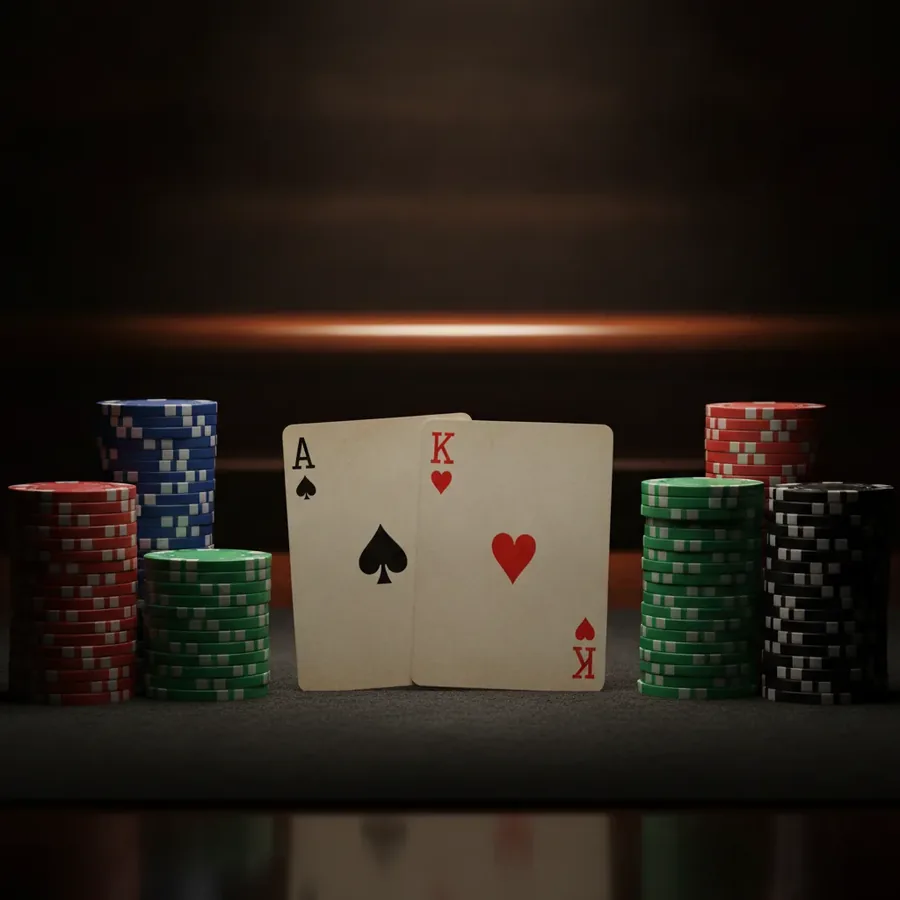
RNG Deals From a Virtual Eight-Deck Shoe
The standard RNG blackjack table uses six decks and a 6:5 payout, producing a 98.15% return with a 1.85% house edge. Replacing 3:2 with 6:5 adds exactly 1.39 percentage points to the casino's edge, which is more than any other single rule change in the range. On a €10 stake, a blackjack pays €12 instead of €15, so the shortfall is €3 every time the best hand lands.
A more favourable RNG setup with six decks, the dealer standing on soft 17, doubling after a split, and a 3:2 payout reaches 99.54% RTP, or a 0.46% house edge. Basic strategy is required to achieve that figure, and it lowers the average cost of play to €0.46 per €100 staked. Doubling after a split improves the return by about 0.14 percentage points, while resplitting aces adds roughly 0.08 percentage points.
The dealer hitting soft 17 works against the player by 0.22 percentage points, and moving from eight decks to six only recovers about 0.02 percentage points. On a €100 stake, a 3:2 blackjack returns €150, but 6:5 returns just €120, a €30 gap that repeats with every natural. A single-deck classic game with a 3:2 payout would reach 99.85% RTP, but that edge is often wiped out by a 6:5 payout structure.
Six to Eight Decks in the Shoe
Six decks instead of eight improves the return by about 0.02 percentage points, according to the rule-effects row. The standard six-deck S17 game with DAS and DOA carries an RTP of 99.54% and a house edge of 0.46%, which is the cleanest benchmark for that shoe size. The single-deck classic game illustrates the broader pattern: RTP 99.85% and a house edge of just 0.15%.
The move from six to eight decks is worth far less than a payout change. A blackjack paying 6:5 on six decks adds 1.39 percentage points to the house edge, while the shoe-size shift costs only 0.02 percentage points. Even the H17 rule at 0.22 percentage points is eleven times larger than the six-to-eight deck difference, putting the shoe-size question well below payout and dealer-stand rules in priority.
For a player comparing live tables, the shoe size is not the decisive figure. Lightning Blackjack from Evolution runs at 99.56% RTP and Quantum Blackjack Plus Live from Playtech at 99.57% with optimal strategy, both above the standard six-deck 99.54%. The difference between those two live games is one hundredth of a percentage point, roughly half the cost of moving from a six-deck to an eight-deck shoe.
The Shoe, the Cut Card and 75% Penetration
The six-deck S17 game with DAS and DOA sets the baseline for shoe play at an RTP of 99.54% and a house edge of 0.46%. The shoe size matters only to the tune of 0.02 percentage points when moving from six to eight decks, so the penetration depth is not the main driver of return for a basic-strategy player. The cut card position influences card counters far more than it changes the published RTP.
The remaining decks stay undealt, and the 99.54% RTP assumes the game is played through that partial shoe without adjusting for the cards already seen. A player using basic strategy does not need to track the cut card to reach the quoted return.
Card counting is only relevant at the insurance stage, where the true count must reach +3 before taking the 2:1 insurance bet makes sense. At 75 percent penetration the counter sees more cards before the reshuffle, which improves the accuracy of that decision, but the basic-strategy player ignores insurance entirely because its RTP is 92.53%. The cut card therefore separates the counter from the recreational player without changing the 0.46% house edge.
Blackjack variants at a glance
| Variant | Payout | House edge | Rule | RTP |
|---|---|---|---|---|
| Blackjack Surrender (late surrender) – rule effect | 50% of the stake returned | −0.08 percentage points | The player gives up the hand after the dealer has checked for blackjack and loses half the stake. Improves RTP by about 0.08 percentage points. Early surrender is worth much more (up to −0.6 percentage points) but is extremely rare. | n/a (rule modifier) |
| Blackjack Split / double / H17 – rule effects | Double – stake ×2 with one card; split – up to 4 hands; split aces usually get one card each. | H17 +0.22 percentage points; RSA −0.08 percentage points; DAS −0.14 percentage points | Dealer hitting soft 17 lowers RTP by 0.22 percentage points; resplitting aces improves it by 0.08 percentage points; doubling after a split improves it by about 0.14 percentage points; 6 decks instead of 8 – about 0.02 percentage points. | n/a (rule modifiers) |
| Blackjack Insurance (6–8 decks) | Insurance 2:1 | 7.47% | Separate side bet of up to 50% of the main bet when the dealer shows an ace. Basic strategy ALWAYS declines it (except for card counters at a true count ≥ +3). With a single deck the edge is ≈ 5.88% | 92.53% |
| Blackjack 6:5 payout instead of 3:2 (6 decks) | Blackjack 6:5, win 1:1 | 1.85% | Replacing 3:2 with 6:5 adds exactly +1.39 percentage points to the casino's edge – more than any other rule change. On a €10 bet a blackjack pays €12 instead of €15. | 98.15% |
| Blackjack Liberal Vegas Strip (liberal rules, 3:2) | Blackjack 3:2, win 1:1 | 0.28% | The most player-friendly rule set: S17 + DAS + resplit + late surrender. Standard deviation 1.15 | 99.72% |
| Blackjack 6 decks, S17, DAS, DOA, 3:2 payout, basic strategy | Blackjack 3:2, regular win 1:1, insurance 2:1 | 0.46% | Dealer stands on soft 17; double down on any first two cards; doubling after a split allowed; no surrender. Basic strategy is required to reach this figure | 99.54% |
Soft 17: Does the Dealer Hit or Stand?
Blackjack Liberal Vegas Strip uses a dealer who stands on soft 17, and that rule contributes to a house edge of 0.28% with a return of 99.72%. The alternative dealer hits soft 17 rule adds exactly 0.22 percentage points to the casino's edge. On a €100 stake the standing version costs 28 cents on average, while the hitting version would cost 50 cents.
Blackjack 6 decks with S17, DAS and DOA reaches an RTP of 99.54% when basic strategy is followed, which leaves a house edge of 0.46%. That compares with the Liberal Vegas Strip at 99.72% and 0.28%, where late surrender is the extra player-friendly modifier. The difference is 0.18 percentage points in favour of the Liberal Vegas Strip.
The rule effect of H17 adds 0.22 percentage points to the house edge, while late surrender improves RTP by about 0.08 percentage points and DAS improves it by about 0.14 percentage points. A player at a H17 table with no surrender faces a noticeably worse return than at a S17 table with surrender, worth roughly 0.30 percentage points combined on top of the base rules.
Early Surrender Is Gone From Many Tables
Blackjack Surrender at Spin Dinero Casino offers only late surrender, where the player gives up the hand after the dealer has checked for blackjack and loses half the stake. This rule improves RTP by about 0.08 percentage points, which reduces the house edge on any table where it is available. A €100 hand surrendered late returns €50 to the player.
Early surrender is worth up to 0.6 percentage points in RTP improvement and is extremely rare, but the late surrender version in Blackjack Surrender is worth only 0.08 percentage points. That gap of roughly 0.52 percentage points means early surrender is a far more valuable rule for the player, while late surrender is a modest adjustment.
Blackjack Liberal Vegas Strip includes late surrender among its liberal rules, helping it reach an RTP of 99.72% and a house edge of 0.28%. Blackjack 6 decks with S17, DAS and DOA has no surrender at all and sits at 99.54% RTP. The presence of late surrender on the Liberal Vegas Strip is one rule difference that separates the two tables.
Splitting Eights vs Standing on 16
Blackjack Split and double rule effects show that doubling after a split improves RTP by about 0.14 percentage points, while resplitting aces improves it by 0.08 percentage points. Splitting allows up to four hands, and split aces usually get one card each. A player facing a dealer 10 with 16 must weigh the split option against the single-hand stand.
Blackjack Liberal Vegas Strip permits resplit and DAS, which are the two player-friendly split rules worth 0.08 and 0.14 percentage points respectively. The combined 0.22 percentage point improvement lowers the house edge on that table to 0.28% with an RTP of 99.72%. Standing on 16 against a dealer 10 keeps the player on a weak total without those rule benefits.
Blackjack 6 decks with S17, DAS and DOA allows doubling after a split but no resplitting of aces, and it reaches 99.54% RTP. The Liberal Vegas Strip adds late surrender on top of resplit and DAS, producing a 0.18 percentage point higher return. Splitting eights against a dealer 10 is a basic strategy move that uses the DAS rule, while standing on 16 gives up that edge.
Insurance vs Even Money When You Hold Blackjack
Blackjack Insurance pays 2:1 on a side bet of up to 50% of the main bet when the dealer shows an ace, but its RTP is only 92.53% with a house edge of 7.47%. With a single deck the edge is roughly 5.88%, still heavily against the player. A €10 insurance wager returns €9.25 on average to the player.
Even money on a player blackjack is equivalent to taking insurance, because the 2:1 insurance payout offsets the main bet loss when the dealer also has blackjack. The 3:2 blackjack payout pays €150 on a €100 stake, while 6:5 only pays €120. Choosing even money locks in the 1:1 win but sacrifices the chance at the full 3:2 payout.
Blackjack Liberal Vegas Strip pays blackjack at 3:2 and carries an RTP of 99.72% with a house edge of 0.28%. The insurance side bet inside that game still holds a 7.47% house edge, so the main game return is dragged down when insurance is taken. Even money on a natural is the same poor-value insurance decision dressed as a guaranteed win.
The Insurance Mistake: 7% Extra House Edge
The insurance side bet at six to eight decks carries an RTP of 92.53% and a house edge of 7.47%, the worst figure of any blackjack option listed. Basic strategy always declines insurance, except for card counters at a true count of +3 or higher. On a single-deck game the edge is still about 5.88%, far above any main-game rule variation.
Insurance pays 2:1 and allows up to 50% of the main bet when the dealer shows an ace. A player insuring a 100 EUR stake for 50 EUR wins 100 EUR on the side bet if the dealer has blackjack, but loses the insurance far more often than it hits. The long-run cost is 3.74 EUR per 50 EUR insured, based on the 7.47% edge.
Compare that with the 0.15% house edge on single-deck classic blackjack or the 0.28% on the Liberal Vegas Strip. Taking insurance even occasionally converts a near-even game into one where the casino keeps 7.47% on every insured portion. The rule change from 3:2 to 6:5 adds 1.39 percentage points; insurance adds more than five times that.
Bet Two Percent of Your Bankroll per Hand
A 2% flat stake per hand is a defensive sizing rule that keeps a session alive through normal downswings. With a 500 EUR bankroll the bet is 10 EUR per hand, and with 2,000 EUR it is 40 EUR. At the 0.46% house edge on a six-deck stand-on-soft-17 game with a 3:2 payout, a 10 EUR hand costs 4.6 cents on average.
The live tables accept far wider ranges: Lightning Blackjack from Evolution runs 1 EUR to 2,500 EUR, while Quantum Blackjack Plus Live from Playtech and Infinite Blackjack from Evolution both run 1 EUR to 5,000 EUR. A player using 2% of a 5,000 EUR bankroll bets 100 EUR, well inside all three ranges but still exposed to the same house edge per hand.
Over 100 hands at 10 EUR each, total turnover is 1,000 EUR and the expected cost at a 0.46% edge is 4.60 EUR. At a 1.85% edge from a 6:5 payout, the same 1,000 EUR of action costs 18.50 EUR. Bet sizing does not change the edge, but it controls how many hands a bankroll can absorb before the expected loss consumes it.
16 vs 10 played incorrectly: most common error
Standing on 16 against a dealer 10 is the most common basic-strategy mistake because the hand looks close to 21 but is actually an underdog. The correct play is to hit in most rule sets, including the six-deck stand-on-soft-17 game with double after split and a 3:2 payout that carries a 99.54% RTP. Deviating from basic strategy lowers the return below that figure.
The cost of the error is embedded in the house edge only if the player follows the chart; any deviation adds an unlisted amount to the 0.46% edge. A player who systematically stands on 16 versus 10 gives the casino extra margin on every occurrence of a common hand. Doubling after a split and resplitting aces improve returns by 0.14 and 0.08 percentage points respectively, but only when the right hands are played correctly.
Late surrender, worth a 0.08 percentage point improvement, is another tool for bad hands, letting a player give up the hand after the dealer checks for blackjack and lose half the stake. On a 10 EUR bet that saves 5 EUR compared with playing out a likely loser. The rule is part of the Liberal Vegas Strip set at a 0.28% house edge.
A Side Bet Every Round: The Budget Lasts 30 Rounds
Infinite Blackjack from Evolution carries four side bets: Any Pair, 21+3, Hot 3 and Bust It, alongside the main game at 99.47% RTP. Side bets generally carry higher house edges than the main bet, and playing one every round drains a fixed budget much faster. A 2% main bet combined with a side bet of equal size doubles the turnover per round.
If a player budgets 30 rounds with a side bet every hand, the total action is 30 times the combined stake. At 10 EUR main bet plus 5 EUR side bet, that is 450 EUR of turnover. The insurance side bet at 7.47% house edge costs 37.35 EUR on 500 EUR of action over 100 rounds, showing how side bets accelerate the expected loss.
These are main-game features rather than separate side bets, but the multiplier potential should not be read as a reason to raise the per-hand stake above 2% of bankroll.
Contact
Live - online chat
Banking









Providers












Spin Dinero Casino 2026